
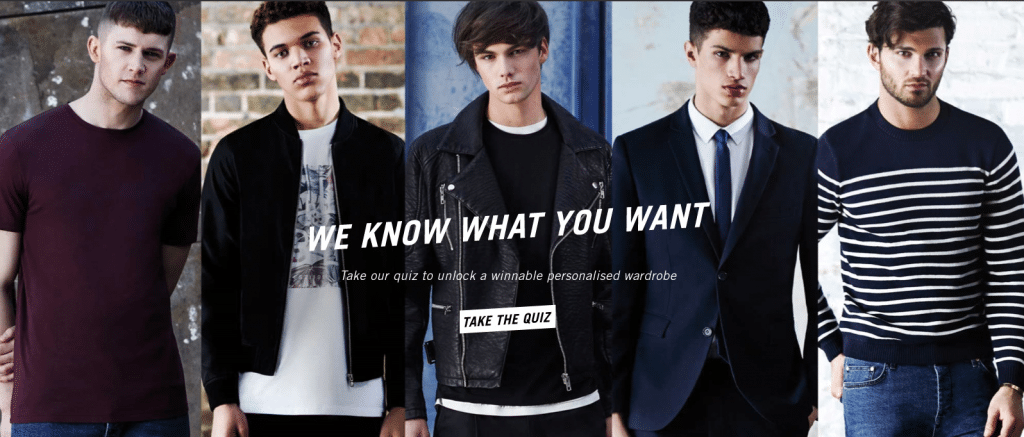
This summer, Topman launched an innovative campaign designed to provide customers with product recommendations based on their personality. Titled ‘We Know What You Want’, the campaign invited customers to take a lifestyle quiz in order to unlock and win a wardrobe tailored to their personal style. The brand explains how it worked
Using an algorithm, Topman were able to use different combinations of answers to provide customers with products that they genuinely loved. Pretty cool, right? Pretty successful too, as 83,000 people took the quiz. The campaign proved that personalisation really does work in retail – as customers who received the bespoke product recommendations converted at a higher rate than customers who just browsed the site. Going forward, those same customers will be targeted with products and promotions tailored to their shopping preferences.
We approached segmentation by placing the emphasis on customer personality types – by enabling customers to define themselves, we were able to target them with personalised content and product recommendations.
With the aim to inform customers that we have something for them, regardless of their shopping habits and opinion of Topman, we created the We Know What You Want campaign. To do this, we recognised that we needed a deeper understanding of different customer types – so focussed the campaign on segmenting our customer base to offer personal advice. Our angle was to appeal to customers to take a personality quiz, to which an algorithm was applied, that would unlock a personalised wardrobe. The wardrobe and further targeted communications all featured different models and adjusted tone of voice for each individual segment.
The aim, put simply, was to accurately segment a significant amount of customers (with a view to long term personalised communication), whilst also increasing conversion on all customers who interacted with the campaign. A further objective was to reach out to potential customers who have either becoming disengaged by Topman or never considered us as a shopping destination in the first place. A key aim of the campaign was also to extract learnings, where appropriate, from our communication and marketing strategy. For example, the fact that the customers were taking the personality quiz allowed us to not only segment them, but to learn more about their lifestyle. It’s market research. Likewise, by reaching out to new customers through display advertising on a wide range of websites we hadn’t previously worked with, we were able to form opinions on where best to target different customer types.
Our first step was to explore the customer segments that we were defining – this would allow us to select models, refine product and product styling, create individualised copy and publish a quiz optimised to ask the right questions. Only when we were sure that we had nailed these segments, did we proceed to shoot, style and create copy, confident in that fact that we were showing each customer a representation of himself. Upon achieving that, we focussed on syndication, testing multiple creative executions across our homepage, social platforms and display advertising – quickly realising that certain creative resonated on some sites and for some personas, but not for others. The quiz itself was based on an algorithm that indicated certain lifestyle preferences could be translated into personal style choices – to ensure accuracy, we tested the quiz on both internal and external user panels.
Our top three hard targets were surpassed. In total, we received 166k visits to the quiz page (over 78 per cent on target). As mentioned earlier, traffic came from a variety of sources with display advertising and the Topman homepage delivering the majority. Interestingly, a certain type of celebrity imagery drove more visits from the homepage than model imagery – a good insight for us. 83k customers then engaged with the quiz (over 316 per cent on target), we anticipated a large bounce rate due the relative unfamiliarity of the content, but actually bounce rate was lower than with regular content – those that visited the page but didn’t engage with the quiz, simply went on to explore other areas of the site. Total email sign-ups from those that took the quiz was 35k – a significant addition to our email base, but with a higher value due to the segmentation that they had been through.